Thursday, January 10, 2013

Date Your Soaps & Recipe Sheets

This was something that I started doing when I made my very first batch of soap. But I soon learned there was a flaw in my method of dating my soaps.

Dating your soaps is very important so you know when it was made, and will know it’s age and about when would be the best time to begin using that soap. Any cold process soap and each variation of it as well as hot process soap really does need about 3-6 weeks to sit on a shelf to what is known as cure. But even though the soap can be used within days it does get much better and less harsh as it ages.

But it’s more than that. What I failed to do with my first number of batches was to date each batch with the year it was made! You may wonder why the year can be so important. It’s because if you want to go back and look at a particular batch you know not just the month and day it was made but the year as well. This can be important if looking at a soap that might be 2 or 3 year old! As we ring in the New Year I thought it would be a good time to mention this important step.

One other very important step that I do feel that is almost critical is to give each batch that you make it’s own batch number as well as it’s own recipe sheet. This sheet has evolved a lot since my first one, as I decided what info I wanted there and what order to put it in.

Then this is printed off on card stock paper because it’s more sturdy than regular copy paper and I use a three ring hole punch to put it into a binder for future reference. Any notes can be hand written on the sheet that you feel you may need later. I’m on my 4th binder now! And there are times when I do go back to my first and second binder to look something up!

This is what I happen to do myself and how I set it up now. I use the “tables” option to set the lines up to make it look neater and more professional. You can adjust the size and width of the lines as well. This works with both Microsoft Office and OpenOffice.org. I took two screen shots to show the top portion of the paper and the bottom portion.

click on photo to enlarge


You will notice there isn’t a spot for the batch number. I just hand write that in on the top right corner of the page. Under the scent I also hand write the mold that was used as well as the number of bars that it made. That way I can go back to get that info later if it’s needed.

I also give each and every recipe I formulate a number. That way I can go back and look at the recipe as a whole as well if I need to.

You will notice on the top right portion I write the number of grams of oil used for the recipe, and the lye solution strength on soapmaker 3, on soapcalc you can enter the water as % of oils or use the lye concentration percent. This number has to do with the amount of water that is added to your recipe. If you want to use more or less water depending on your recipe and what your comfortable with. Below that I write the lye discount or superfat. I personally prefer to soap at 7-9 percent rather than the typical 5%. Then again this also depends on the recipe and the oils used. Some oils go rancid faster than others and if your superfat is too high you can set yourself up for DOS. (dreaded orange spots)

Below that stretching across the page I add a table to write down the hardness, cleansing, conditioning, bubbly lather and creamy lather benchmarks that are found on soapcalc. This helps me to get a feel for the soap before it’s even made, but also to compare recipes at a glance after they are made by the feel of them.

Next you can see I leave a space for each ingredient. I type in the percent of each oil used, the oil actually used and the number of grams needed. I don’t type anything in the last column. Instead the numbers are hand written in here when the recipe is made up. That way if the recipe calls for 149 grams of coconut oil, I can add the number that was actually put in. Sometimes we over pour slightly one oil and may compensate by under pouring another.

click photo to enlarge

Now for the bottom half of the page.........

Shown in the purple font I write the amount of liquid the recipe calls for as well as the weight of the lye required.

I prefer to use the 50/50 solution as it saves me time when I make soap, but if you do not use that method then just add in the amount of liquid used and the lye amount. Still keep that bit above in the purple because you will often find you will like to split your liquid rates up. I suggest mixing water with your lye. Use the same amount of water or a little more than the amount of lye required. Then as you see below I had additional water added.

Because I want a one stop page for all recipes I do figure the batch for the grams needed as if the batch did require a vanilla stabilizer added. But if it’s not needed it’s crossed out and the math is already done as you see the number in brackets to the side. I also add sodium lactate to every batch and you do want to consider this number as part of your liquid used. So the match numbers of the sodium lactate, additional water, vanilla stabilizer and the amount of water that was used and was mixed with the lye must equal the number of total liquid used that is between the grids. I hope I wrote that out to be clear enough to understand.

You will notice that I have three amounts listed for the powdered milks that I use. If you change the size of your batch then these numbers will need to be updated. I do that so I can make any of the three with this recipe and have one sheet with the math already done. I cross out the two not used and write in the number I need to use and also how much was actually used. The advantage of using powdered milks is that you can have the total amount of the liquid figured as powdered milk and still use water to mix with your lye. So the amount of powdered milk used is based on the number of the total liquid amount used in the purple as shown.

At the very bottom of the recipe sheet I have the usage rate for each milk written down.

I also like to add other additives into each soap batch. For the most part these don’t change but if they do I would just cross them out or hand written them in at the bottom of the page. Note I don’t have any colorants written down as part of the recipe. This can change batch to batch so I just hand write them in on the bottom of the page as well.

Because I like things to be as accurate as possible for the additives I like to figure them in terms of PPO. Per Pound of Oil. That way I can make a small test batch and if I like it I can go back and figure a larger batch and the additives will always be the same regardless of the mold used. After all we don’t always use even number of pounds for the oils for every recipe and batch or mold! So to figure these numbers for example for my test batch of 300 grams of oil and I want to add 4% PPO of sugar I multiple 300 times 4% to get the number of 12 grams of sugar to add. With the exception of eggs, they make soap more moisturizing so I do figure that up to 1 egg per 300 grams of oil give or take depending on the size of the batch. I don’t use partial eggs in a recipe.


On the back of the recipe sheet I place a sticky label that I printed out.  On that 3x4 inch sticky label I type out the ingredient list in proper order using the tables.  This make it easier to go back when I need that info to copy it down onto my soap label. Because I don't make any claims about my soap other than it's soap and that makes it so it can be labeled as a soap rather than a cosmetic I don't go into detail about the soap colorant added other than the name of the soap colorant.   If you make claims about your soap that it will need to be labeled as a cosmetic.  But most of all don't make any medical claims about your soap because that makes it an over the counter drug and you don't want to go there with the FDA. 

Friday, January 4, 2013

Solid Lotion Bars Recipe

Solid lotion bars is a nice alternative for those who don't want to buy or use preservatives in a liquid lotion. 

But remember that that they are mostly oils so not only does a little go a long ways but some people may still find them too oily for their skin.


This is a recipe that I created for the members of Soaps-N-Lotions.

  1. ~ 31% Beeswax
  2. ~ 31.5% Cocoa Butter
  3. ~ 14.5% Fractionated Coconut Oil
  4. ~ 9% Sweet Almond Oil
  5. ~ 8% Jojoba
  6. ~ 1% Tocopherols, Vitamin E
  7. ~ 5% Fragrance Oil or Essential Oil

You can make a small batch or a large batch.
If you need a calculator to do the math for you this is a good one to use.  Simply type in the ingredients and the percent of each to use and calculate it into weights.
 http://www.wholesalesuppliesplus.com/Calculators/Batch_Size_Calculator.aspx

Select the mold or container that you will be pouring into.   Hard plastic molds that are cute shapes make really cute lotion bars.  Just remember that you really need to put that bar into a solid container for storage.   Twist up tubes also work really good for these lotion bars as well. 


It's Almost All Melted.........

Decide if you want to melt your ingredients using the microwave or the double boiler method. I put mine in a 4 cup glass measuring cup and heated it in the microwave.  Once you decide this select the container that you will be using and weigh out the first 5 ingredients that you will be using.  You don't want them overly hot, but if it's not hot enough it will cool off and harden.  It's really not that hard, and easy to know the difference.


 It's not fully hardened, you can see the color difference.

Once everything has melted and it's not too hot or too cold add your tocopherols and your the scent of your choice.  If you don't want it scented just replace that percent with a liquid oil of choice.  One that is already in the recipe or a different one.    Pour your mixture into your mold and let it set until it hardens.  Once it's hard pop out of the mold and it's ready to use.   If you made it in a mold have a container ready to store your lotion bar.  That keeps it clean and ready to use, but also makes it handy to take with you.


The Finished Lotion Bars!!! 


Any liquid oil can really be used for lotion bars.  Just change out for what you want to use or what you have on hand.  But keep in mind that some oils do feel oilier than others on the skin which is why I selected the oils that I did for this recipe.   It will still feel oils because after all they are oils, but just not as oily as other can feel.

Happy Crafting !!!!
Krissy


Thursday, December 27, 2012

Great CP Soap For Dry Winter Skin !!! Uses Tallow and Lanolin

If you suffer from dry skin in the winter time then you might want to consider using a soap with lanolin in it.  Lanolin is technically a wax and makes it more moisturizing to the skin when used in soap or a leave on skin care product such as a lotion or a cream.


Use SoapCalc to enter your recipe to make the batch size that you need for your mold.

Superfat this recipe between 7% and 9% for extra moisturizing benefits.   This allows more oils to not saponify or change into soap when you mix in your lye solution.   For this recipe shown I superfatted at 9% to make the most of it.

30% Tallow (beef)
10% Coconut Oil
12% Palm Kernel Oil
16% Castor Oil
05% Lanolin
07% Avocado Oil
10% Shea Butter
10% Olive Oil

Keep in mind that each oil is different and brings a very specific property to the finished bar of soap. 

On SoapCalc the benchmarks for this recipe are.....
Hardness 42
Cleansing 17 
Conditioning 49
Bubbly Lather 31
Creamy Lather 40

Use the liquids of your personal preference.  While water can be used why not get a little more creative and try using a milk.  Either a powdered milk or a dairy or non-dairy milk found in the dairy section of your favorite grocery store.

Other additives can be used that you prefer.   I also added a whole egg into my recipe as one of my additives. 

If you have not made cold process soap before I recommend that you learn the process first.   You can join a forum such as my fourm the link is at the top right side of the page to learn more about how to make cold process soap and ask questions. 


In the first step I put all my solid oils and liquid oils into my soaping bowl.  I prefer to use plastic bowls when I soap and this one happens to be from a dollar store.  So it doesn't need to be fancy.   I also like plastic because I also melt my oils in the microwave.  I don't heat soaping oils until they are very hot, just hot enough to melt the solid oils.

Not shown but I prefer to use a 50/50 lye solution so I don't need to wait for cool down time.  But I pour that into a small plastic measuring cup to be used later.   If you are making up your lye solution, now would be the time to get that mixed up so it can set aside to cool down.  Raw silk fibers were also dissolved into my lye solution when it was made up.  


In another measuring cup, this one happens to be a plastic 4 cup measuring cup that is also from the dollar store.   Inside this cup I have my additional water that is needed that wasn't mixed in with my lye.  Also mixed inside this mixture is my powdered coconut milk used at the rate of 4.5 grams per ounce of water.  sodium lactate, sugar, sea salt, talt and a whole raw egg.  It's a bit clumpy but I don't worry about that at this point.


  In my bowl of melted oils I dump the coconut milk/egg contents from the above measuring cup.  I also added my fragrance oil and a little titanium dioxide at this point and used the stick blender to stick blend it into a creamy mixture.  Now with the additional liquid it makes it easier to stick blend it and get any clumps out.


Also not shown but I poured a little glycerin into the bottom of a 2 oz white solo plastic cup along with a little bit of the powdered colorant that I chose to use.  I used three colorants, each having their own cups.   From Brambleberry I used Electric Bubblegum, Fizzy Lemonade and Aqua Pearl Mica.  Using a spoon I mixed the colorant into the glycerin.  I used about 1 teaspoon per color of glycerin so it wasn't much, but just enough to get the job done.

I'm also not showing the rest of the steps because I was working and it makes it a little hard to take your own pictures.

If you haven't already put on your goggles and gloves this is the time to do that!  I usually don't put them on until I'm ready to mix the lye solution into the prepared oil mixture. 

Because I don't want this to move to fast, and I wanted the fluid consistency of my batter I put my stickblender aside. Instead I pulled out my old fashioned whisks.

I whisked it together until it was mixed well then I poured some of the batter into two other measuring cups.  I didn't measure how much was added but just eyeballed it instead.   I spooned each colorant into a different bowl and mixed the colorant into the soap batter.

When it was fully incorporated I began to use a regular soup spoon and poured a spoonfull of batter into each mold compartment.  For this batch I only used 300 grams of oil and I know that amount will fill four compartments of the yellow WSP 3" round silicone mold.   So I poured a spoonful of each color in and kept rotating colors until the colors were all used up.  Because the batter is very fluid it pours into itself creating it's own swirl.  I dripped the batter off the spoon tip in going slowly in a circular patter so it didn't all go in once spot.  I hope that makes sense.

Then once I was done, I used a small spatula and scrape out the very last of the batter into my bowls.   Then I used the tip of a spoon to very so carefully just swirl the top of the soap to give it an elegant look.

And this is what the soap looks like just after it was poured into the mold.  Because I want to keep the light colors and milk was used I am avoiding the gelling process and the mold was popped into the fridge immediately after this photo was taken. 


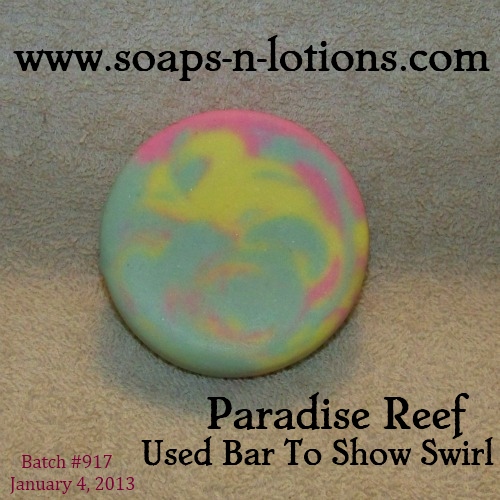
Paradise Reef was the scent used for this soap.  It behaved very nicely without any troubles.
http://www.naturesgardencandles.com/candlemaking-soap-supplies/item/df-0222/-Paradise-Reef-Fragrance-Oil-.html


Scent Description
Let's get away and go deep-sea diving at Paradise Reef. A popular vacation get away place. Paradise Reef is a sparkling fragrance with salt water and fresh air notes. This fragrance begins with notes of nectarine, bird of paradise, and water lily, followed by middle notes of passion flower, orchid, and hyacinth. A well-rounded fragrance empowered by fresh air and salt water notes.

Don't you just want to scrub up with one of these? 


Updated January 10, 2013
I took a photo of a bar that's been used for a couple of baths to show what the swirl looks inside.  Every time you use it the swirl changes as the swirl changes through out the soap as it was poured!


Sunday, June 24, 2012

Coconut Water

Coconut water is another option as the liquid being used in your soap.   But because it comes from the coconut and may have a small amount of oils in it I don't recommend mixing your lye in with the coconut water.  But rather mix the same amount of water as your lye calculator calls for lye.   Then subtract the amount of water used from the total amount of liquid called for as your coconut water.   

When using water in your recipe you can take advantage of using powdered milk such as powdered coconut milk.  Use this at the rate so your water becomes coconut milk.  So your two liquids in your recipe now become water and coconut milk.  

The rate for using powdered coconut milk is 1 tbs powdered coconut milk for every two ounces of water, or 1 ½ tsp of powdered coconut for every ounce of water.   For soap this isn’t a big issue if you get more powdered coconut milk than you need for the water used.  But if you’re using your coconut milk for lotion it becomes more critical to make sure you’re not using more than you need.  I also find it easier to weigh out the powdered coconut milk rather than use a measuring spoon.   Use 4.5 grams of powdered coconut milk for every ounce of water.

If you’re like me and your recipe is figured into grams I just calculate my liquid amount into ounces and do the math.

For example: If your recipe calls for 385 grams of liquid that you need powdered milk for just divide that by 28.   That gives you 13.75 ounces.  Then just multiply that by 4.5 to get the number of grams of powdered coconut milk you need to weigh out.

Coconut water is amazing in soap, and the combination of coconut milk and coconut water is even better.  Plus it has great label appeal having both of the liquids used in your soap!

Saturday, January 28, 2012

Castile VS Bastile ~~ what does that mean?

Castile and bastile are two terms that can mean anything and everything to many different people. I've seen soaps listed/made as castile or bastile but they contained very little olive oil.

Traditionally speaking true castile soap should only contain one oil and that's olive oil. The lather from a castile soap is one that people either love or hate. Castile soap is very gentle and highly moisturizing. The lather is very creamy rather than having big bubbles, but also many describe the lather as slimy.

The term bastile came along because people didn't like the lather of pure castile soap. So they added a few additional oils to boost the lather while keeping the high olive oil content of the soap. A good bastile soap will contain more than 60% olive oil but the more olive oil used the better.

Both terms castile and bastile can also be called a loose term because it can mean something different to different people. It might contain as little as 50% olive oil (or even less) or as much as 80% or more of olive oil. I've seen castile and bastile soaps recipes listed with as little as 25% olive oil.

But both castile and bastile soaps may contain liquids other than water. They may also contain other additives such as silk, clay, or even oatmeal.   Fragrance and color may also be added to either soap to make them more desirable and unique to use. 

Both of these soaps become much better as they age.

Since castile soap uses 100% olive oil I won't go into a recipe for that.   But here are a few bastile soap recipe options.   Remember to always run your recipe through a lye calculator such as soapcalc.   Select the total weight of the oils you plan to use and the calculator will figure out how much of each ingredient you need to weigh out to complete your soap.

Variation #1
Olive Oil 75%
Coconut Oil 12%
Castor Oil 13%

Hardness 22 ~~ Cleansing 8 ~~ Conditioning 75
Bubbly Lather 20 ~~ Creamy Lather 26

Variation #2
Olive Oil 85%
Castor Oil 15%

Hardness 14 ~~ Cleansing 0 ~~ Conditioning 84
Bubbly Lather 14 ~~ Creamy Lather 28

Variation #3
Olive Oil 65%
Coconut Oil 20%
Castor Oil 15%

Hardness 27 ~~ Cleansing 13 ~~ Conditioning 70
Bubbly Lather 27 ~~ Creamy Lather 27

This gives you a few options to start with.   Coconut Oil and Castor Oil are used because they are two of the most popular oils that add to the lather of the soap that is desired.  Coconut oil adds a wonderful lather but if too much is used it can be very drying to the skin.  Unlike castor oil which also makes a nice lather is very moisturizing.

Thursday, June 9, 2011

Laundry Soap

I decided to write about laundry soap because it's a popular product that is made, but quite honestly I don't think it's as good as everyone thinks. And I want to be able to prove why I believe this.

This is one of the most popular liquid laundry soap recipes found on the internet.
1/3 bar Fels Naptha Soap (new bar is 5.5 oz) or use your own homemade soap which amounts to 1.83 oz of any type of soap.
½ cup Borax (4 oz)
½ cup Washing Soda (4 oz)
A total of 32 cups of water added through out the process of making this soap.

To make this easier, I didn't figure in the 1.83 oz of soap so the total volume of your homemade laundry soap using this recipe amounts of 33 cups of liquid which requires ½ cup per load. So the whole batch makes 66 loads of laundry. If each cup weighs 8 ounces then the total weight will be 264 ounces.

In cutting out some of the math, this means that this is how much of your active ingredient is used.
Borax 1.5%
Washing Soda 1.5%
Soap 0.7%
Water 96.3%

So what does that mean when you add ½ cup (4 oz) to your washer. I'm going to include the weight in ounces and grams. So you need to remember that 1 oz equals 28 grams
Borax – 0.06 ounces = 6 grams (about 1 tsp)
Washing Soda – 0.06 ounces = 6 grams (about 1 tsp)
Soap – 0.028 oz = 3 grams (about ½ tsp)
Water – 3.85 oz = 107 grams


But just to be fair I found another recipe that is for a powdered laundry soap recipe.
2 ½ ounces of grated soap, (suggests to use fels naptha, zote or octagon)
1 cup borax (8 oz)
1 cup washing soda (8 oz)
Use 1 tbs per load.

This makes a total of 18.5 oz of laundry soap.
1 tbs = 1 oz = 28 grams


14% = 2.59 oz soap
43% = 7.8 oz borax
43% = 7.8 oz washing soda

Soap -- 0.14 oz = 3.92 grams (aprox 1/2 tsp)
Borax -- 0.42 oz = 12 grams (aprox 2 tsp)
Washing Soda -- 0.42 oz = 12 grams (aprox 2 tsp)

Do you see that your not adding enough active ingredient to any real cleaning and your basically just washing your laundry with plain water.


Now lets look at washing soda. The instructions on the package say it's a laundry booster. To use the package and website says to use ½ cup (4 oz) washing soda ALONG WITH your usual amount of liquid or powder laundry detergent. For large or heavily soilded loads use 1 cup (8 oz) washing soda ALONG WITH your usual amount of liquid or powder laundry detergent. So now that you know that, why is it that people think that this product can be used alone but reduce the amount down to 1-2 tsp without the addition of a laundry detergent which is what is doing the work of cleaning the laundry.

Now lets look at borax. The instructions on the package says that ½ cup (4 oz) of 20 mule team borax can be added to every load along with your regular detergent to do the following jobs. Improve cleaning power of the detergent, helps remove tough stains, natural alternative to color safe bleach, deodorizes and freshes and naturally softens water. So just like the washing soda who decided that 1-2 tsp could get the job done without the benefit of a laundry detergent.

The soap added which amounts to approximately ½ to 1 tsp really isn't enough to get the job done either, along with the other two active ingredients in homemade laundry soaps. Do you really think that using so little is effective when the two main ingredients say to use much more along with your regular detergent? So admit it, your washing your clothes with a lot of hogwash and water.

Last but not least lets look at what's in a commercial made laundry detergent. Regardless if your buying the expensive stuff or the cheap stuff they are going to contain much of the same ingredients.
The first detergent also known as a surfactant or artificial soap was created during world war II so they have been around for quite some time, and the quality has changed over the years. But to put it in an easier way to understand it has partials that attach themselves to the dirt and grease to pull them away from the clothing fibers and into the wash water. Natural soap does that as well but if you look at the above recipes they don't have very much soap added.

One thing that the homemade laundry soap doesn't have added that laundry detergent has are the other ingredients that are added. They add special ingredients that help prevent the soil that has been sent back into the wash water from going back and settling back onto your clean laundry. So the partials of grease and dirt stay in the wash water and go down the drain when the extra water is spun out. They also contain a number of ingredients that help maintain the color and whiteness of the fabric to some degree. The commercial laundry detergents also contain special enzymes that help break down the stains in your laundry so the detergent can do it's job to remove them. This is why many detergents say to pre-soak heavily soiled loads. Because of the amount of detergent or surfactant used in commercial detergents they also add ingredients to help control the amount of suds you see in your load. So there is more going on than what your seeing by the bubble action. The reason why they add the ingredients to control the amount of suds the surfactant produces is because to many suds can ruin your washing machine, and they are also harder to rinse away.

If you read up on Wikipedia under laundry detergent you will read how modern detergents contain three main components. It also states that “Soap is, by weight, relatively ineffective, and it is highly sensitive to deactivation by hard water. By the 1950s soap had almost been completely replaced by branched alkylbenzenesulfonates, but these detergents were found to be poorly biodegradable. Linear alkylbenzenesulfonates (LABs), however, proved to be both highly effective in cleaning and more biodegradable than the branched relatives. LABs remain the main detergents used domestically.”

50% of the product is what is known as the builder. These are water softeners are combined into several ingredients. Washing soda is one of them, along with zeolites. Their function is to remove problematic ions. Another common builder is sodium triphosphate to help soften the water further.

7% of the product is bleach that are made up of a vegetable origin. Sodium perborate is used to activate the oxygen. Sodium hypochlorite is also used which is commonly known as “bleach” to help with the removal of stains. Another product called tetraacetylethylenediamine is also used as activator for activated oxygen. This helps to release the natural hydrogen peroxide during the wash cycle.

15% of the product that is something often called sodium dodecylbenzenesulfonate which is a particular surfactant that is used in laundry detergents. The surfactant is what is doing the cleaning and is a particular ingredient that doesn't function exactly like “soap” does.

2% of laundry detergents are enzymes. These help dissolve and remove the various stains that can be found on your laundry.

What makes up the remaining 26% of your laundry detergents. They include ingredients to counteract the foam produced by the surfactant added. Corrosion inhibitors are also added to prevent damage and rusting of your washing machine. It can also contain an ingredient to help the colors from bleeding out and on to another article of clothing. It contains ingredients that help prevent the dirt and grease from being redeposited onto your clean laundry after they were pulled away into the water. Other ingredients might be fabric color brighteners, fabric softeners along with very particular perfumes that won't affect the coloring of the fabric in the wash.

So by reading that you understand that your laundry detergent is more than just soap. It is a multitasking ingredient that the common man just can't replace with a few teaspoons of soap, washing soda and borax.

Now that you know this, you can see that commercially made laundry detergent is made with very specific reasons. Now you can make your own decision if this is something you want to continue to buy or if you want to risk it and make your own. .

Monday, October 18, 2010

Tomato Juice ~ not just for drinking

If Burts Bees can do it why can't you? 
However I'm sure yours will be a lot better.  

Did you know that you can use your favorite soap recipe to make your own?   It's very simple to do.   All you need to do is to substitute your usual liquid for tomato juice.   But  you can also use a portion of the liquid as tomato juice and the difference being something as luxurious as heavy cream.   

Regardless of the amount of tomato juice that you are choosing to use you can mix your lye directly into your tomato juice.  


If your family is like mine you don't go through big bottles of tomato juice to make it worth while to buy a big bottle or let alone the cost of the small single serving cans.  There are other choices.   


Tomato paste is very cheap to purchase but you might not have realized that you can also use that to make your own tomato juice.  All you need to do is to mix 1 can of tomato paste with 4 cans of water and mix well.     You can then mix up only what you need and freeze the rest or freeze the tomato juice that you just made up for later use.  I would suggest mixing up the amount you will need for your batch using the 1 part to 4 part concept and saving the rest to use in cooking for the family dinner. 


But perhaps you found tomato sauce on sale or that is all you have.  You can use that as well.   Simply use equal parts of tomato sauce and water and make your own. 


Best of all this is an ingredient that you can buy at your local grocery store while your shopping for your own dinner and no shipping is needed.   However you can buy dried  powdered tomato from several vendors but it's really not necessary. 

But why should you consider using tomato in your soap?  There are several reasons actually and it's really good for the skin.   Many people use tomato in their facial complexion soap.   Tomatoes are most well known for being high in beta-carotene.  But it's also high in vitamin E.   It's those antioxidants that encourage people to use it.    


So I hope you consider using tomato juice in your next batch of soap.